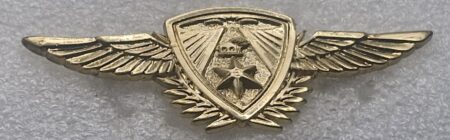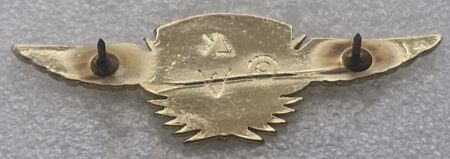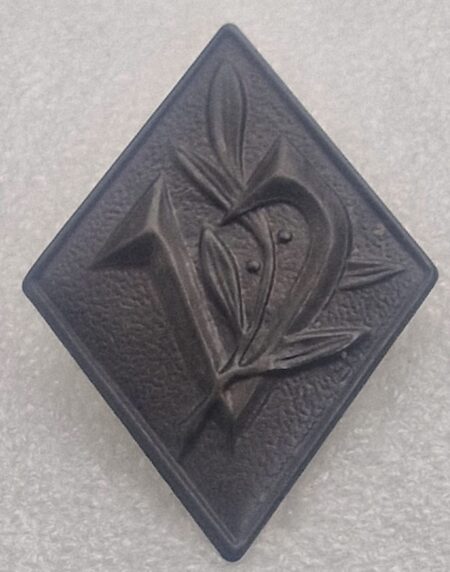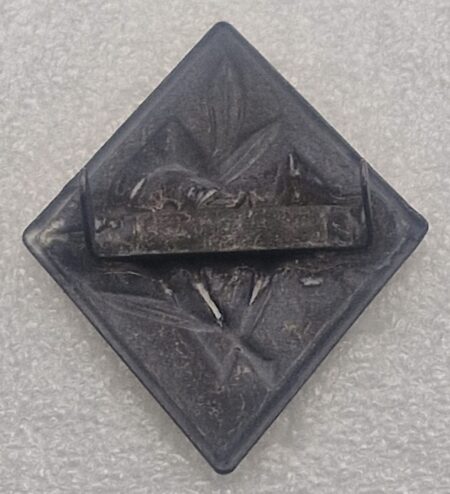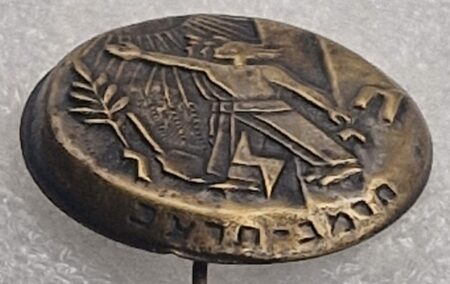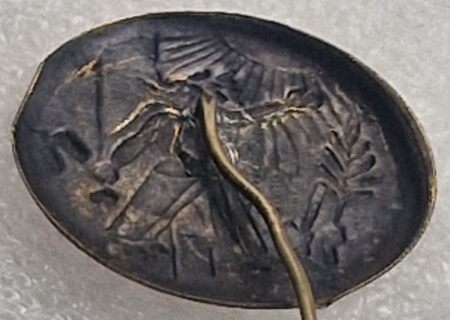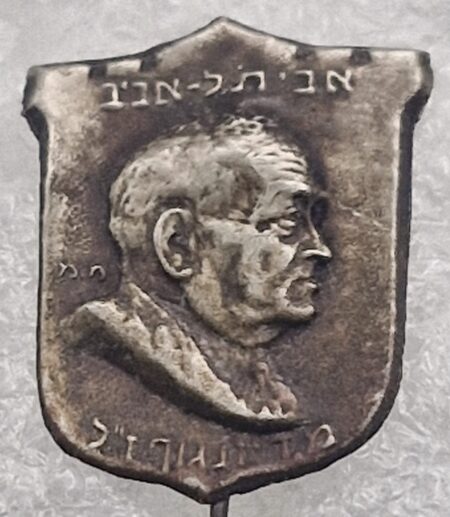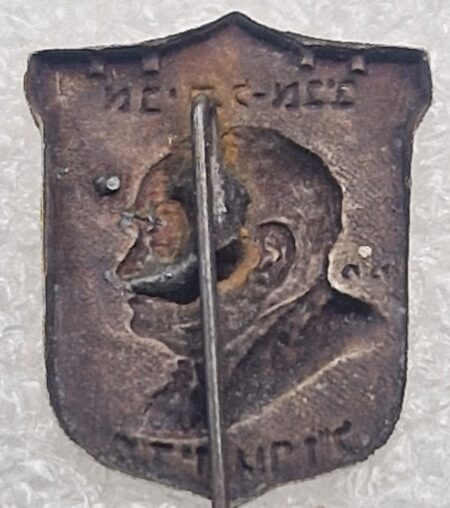
| Weight | 1 g |
|---|---|
| Dimensions | 26 × 17 cm |

Sold
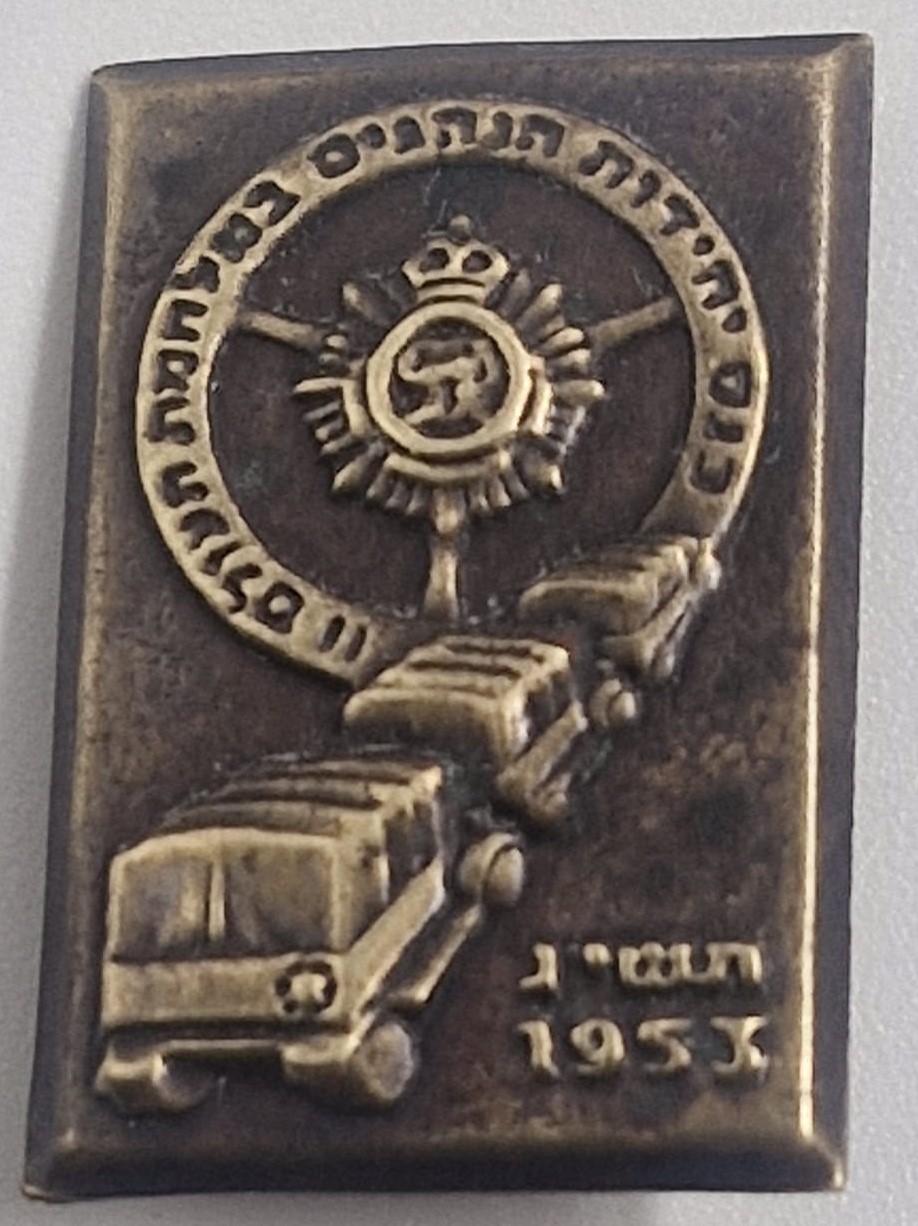
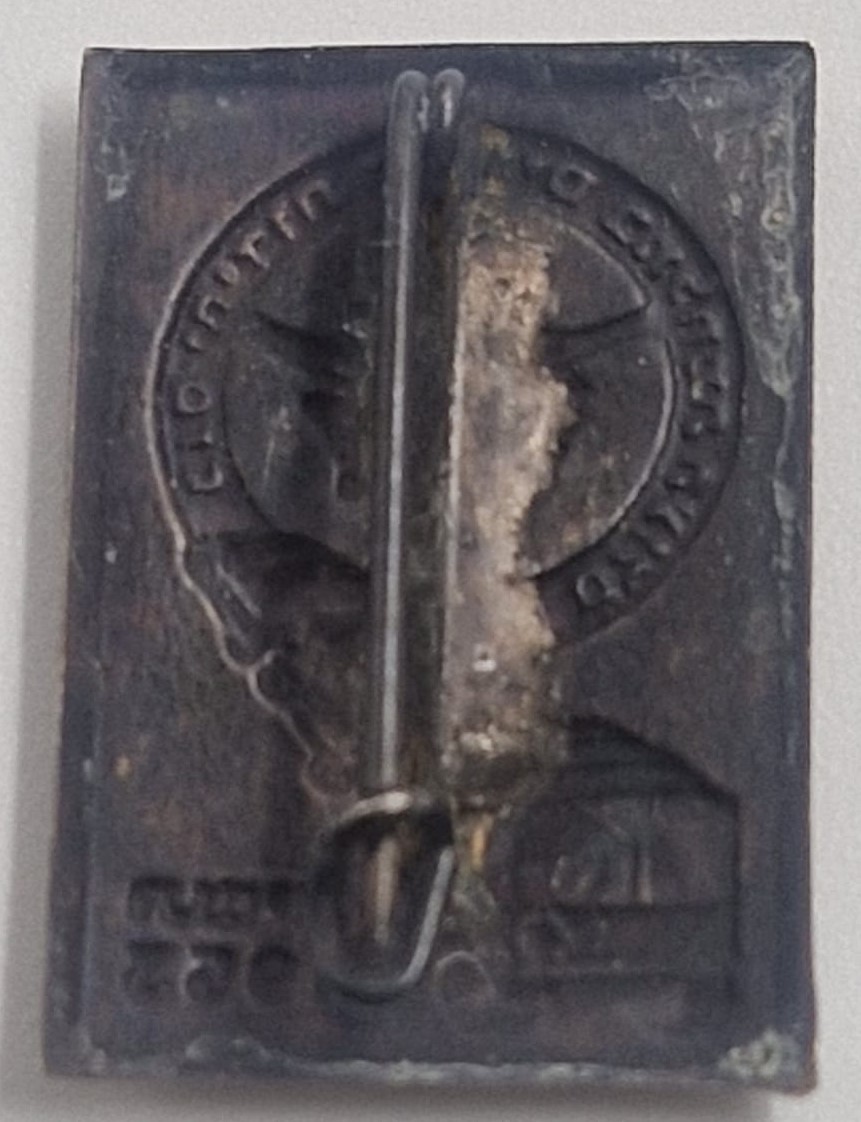
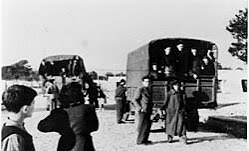
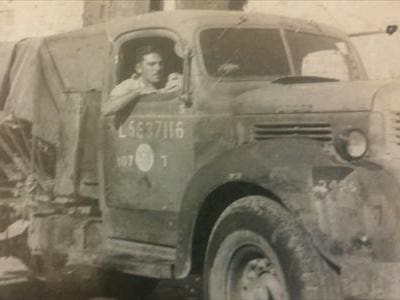
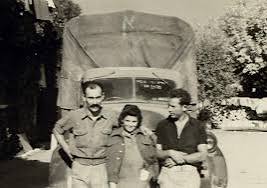
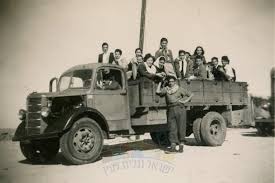
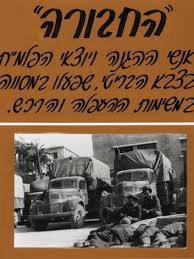
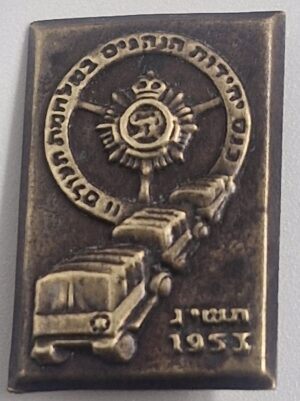
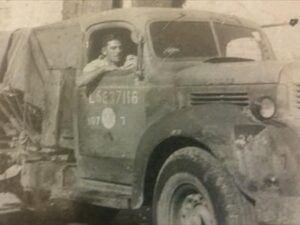
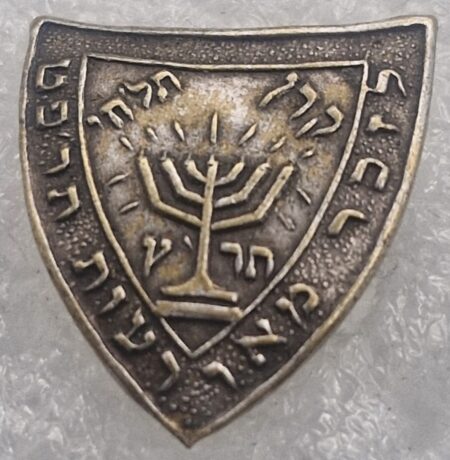
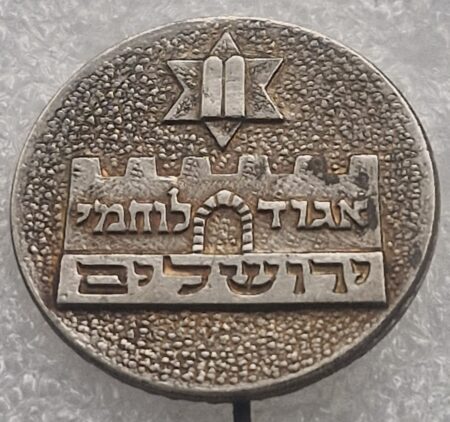
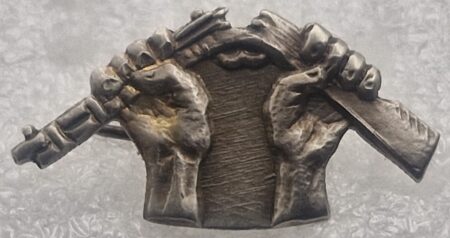
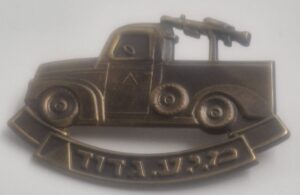
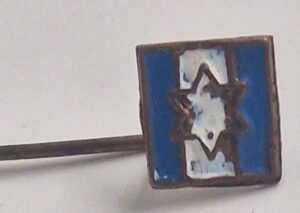
“Yael” Conference in 1953 (Hebrew Transport Unit) The unit of drivers from the Yishuv volunteers in the British Army during World War II, consisting of 6 companies under the command of Colonel Henry Osmond
$100.00
Transport Company 462
462 General Transport Coy. Was established in April 1942, on the basis of veteran soldiers of the transport company 179.
In its early days, the construction of the fortification line at El Alamein was used. At the beginning of June she was sent to the area of Alexandria, to reorganize.
Here Major Harry Yaffe, commander of the Transport Company 179, and Major Israel Boganov, commander of the 462th Transport Company, replaced them. Under the command of Jaffe, a Jew who emigrated from South Africa, the company was sent to Beirut in June 1942, but the British army’s collapse in the Western Desert at the end of June and the advance of the African Corps led by Rommel to El Alamein led to a British decision Alamein.
The company led an Australian division from Syria, as reinforcements to the Eighth camp in El Alamein and participated in the fighting against Rommel in late June and early July 1942.
Even before the drivers arrived at the front, they were bombed from the air and evacuated their first casualties. During July, the company included three dead and fifteen wounded.
Company 462 operated in the Western Desert throughout the battles in El Alamein and after the British offensive in October 1942, participated in the pursuit of the “Eighth Camp” after the German enemy retreated to Libya, and the transport of ammunition to the troops.
Its members were veterans of the Eretz Israel volunteers, and the period during which they served on the Al-Alamein front made them veterans of their feelings. In those days, the unit became a source of pride and example for other transport units. It was the first Hebrew company to be sent to Malta as part of preparations for landing in Sicily.
On April 29, 1943, they sailed from Alexandria aboard the ship Erinpura, in a convoy of 27 ships, 334 officers and soldiers of the company (20 of the unit sailed on another ship). Except for her commander, Major Jaffe, the company did not know that the destination of the convoy was Malta.
On Saturday, May 1, 1943, the convoy of ships was attacked by 12 German planes. The Arinfora was hit and sank quickly in four minutes. The air attack continued, and the German planes fired machine guns at the survivors in the water around the ship.
A short time later, darkness fell, which made rescue operations difficult, but prevented the continuation of the air strike.
Half of the survivors were assembled by the minesweeper “Santa” and half by the Greek destroyer “Adrias.” 139 The soldiers of the company perished in the disaster (see details below).
Many others were injured and did not return to the unit. The survivors received a maternity leave for recovery.
In July 1943, Regiment regrouped in the Sarafand camp and absorbed new volunteers. In September 1943 she was sent to Italy and landed at the head of the beach in Salerno, where she evacuated the unloading platforms and pushed supplies, ammunition and fuel to the fighting units on the front. When the front stopped on the Volturno line, the company was taken back and employed to evacuate the unloading beaches from the equipment. The unit operated within the framework of the Tenth Corps.
As the front advanced northward, the unit was still left behind on the Salerno coast. The company commander, Yafe Yaffe, moved to command a unit of British tank transporters, and was replaced by his deputy, Dov Shemer (Morak).
It was not until August 1944 that the unit was removed from Salerno, and advanced to the vicinity of Rome and at the beginning of 1945, to the north, to the area of Florence-Livorno. As the routine employment continued, the unit lost its military and disciplinary tension, causing internal friction between veterans, survivors of the sinking disaster, and the new command echelons. At the initiative of Eliyahu Cohen (later Major General Ben-Hur), several dozen veterans of the unit were transferred to other units.
In addition to her military duties, the company’s fighters took part in locating Jews and providing them with assistance. The activists of the Jewish units divided the area and the responsibility. Almost every unit was established with a training point, which the unit was responsible for maintaining and supervising.
The company took over the Florence-Livorno area and held the training of Magenta near the city of Milan. In the wake of the last offensive in April 1945, 462 was promoted to Bologna, where it was part of the 13th transport column. Some of its members joined the convoy, which led the Allied Command Mission, to the German surrender. After the victory the company was transferred in early June, from Bologna to Milan, and its platoons were sent to Turin and Genoa.
In the company 462, a group of activists, headed by Eliyahu Cohen, who played a central role in the organization of the illegal immigration from Italy after the war, was the first company to be dismantled in Italy.
In August 1945, a detachment of younger soldiers was transferred to the transport company 468, and in October the rest of the company sailed to Egypt and from there its soldiers left in the coming months to be released from the army in Palestine.
To the list of casualties of the Hebrew Company for Transport 462 Coy GT – click here! (missing limk!)
Transport Company 650
Company 650, 650 General Transport Coy. R.A.S.C. Was the last Hebrew transport company to be established in the fall of 1942. Its commander was a British Jew named Major Charkham, and his deputy was Shmuel Ne’eman (who was also the Hagana commander) who replaced him in April 1944.
The unit was parked in Palestine and carried convoys from Haifa to Iraq. In these convoys, emissaries of Mossad L’Aliya Bet, Haganah and Hehalutz were smuggled to Iraq, as well as a wireless transmitter to Enzo Sereni, who served as Mossad emissary from Baghdad and served the pioneering underground in Iraq until the War of Independence. On their way back to Palestine, the company convoys smuggled immigrants from Iraq, most of them Jewish deserters from the Free Polish Army commanded by General Anders, who came from the Soviet Union through Iran and Iraq to Palestine and Egypt and then to the Italian front. In September 1943 the company went to Italy and took part in the landing of the Allies at the head of the coast in Salerno.
It was the second transport unit that landed in Salerno, and in its early days dealt primarily with leading the Corps of the 10th Corps to and from the front line. Another part of the unit was transporting ammunition and other supplies from the Salerno unloading seaports to more forward bunches. With the retreat of the Germans to the Volturno line north of Naples, and the stabilization of the front there, the unit’s tasks changed. Company 650 was now engaged in a routine evacuation of the ants and occasionally transporting bridge materials to engineering units of the fifth camp.
In the spring offensive of May-June none of the Hebrew transport units participated, except for part of the company 650 commanded by Ne’eman, who landed at the head of the beach in Anzio, south of Rome, and took part in the battles that took place there.
Before the attack on the Gothic line, the company was promoted northward. The unit’s operatives divided the liberated areas in Italy in terms of responsibility for locating Jews and providing them with initial aid. The company took over the Florence-Livorno area. Toward the end of 1944, the company arrived in the wake of the Allied summer offensive. Where she worked mainly with the help of the engineering units in the transportation of fortification materials and bridging equipment and in routine local functions. The commander of the unit, Shmuel Ne’eman, completed his post and was replaced by another Jewish officer, Eddy Kahanov, who was one of the veteran officers of the Israeli army. In April 1945, following the Allied last summer offensive, the unit was operated as part of the 86th transport column.
At the beginning of the progress she was transferred to Florence. After the conquest of Bologna, she moved to this city, and her trucks operated throughout the Po valley and northern Italy. From time to time convoys were sent to the south, bringing supplies directly to the port of Naples. In August 1944 the company was integrated into the transport of soldiers of the Eighth Camp to and from Austria. In Bologna, the company adopted the training farm in Nonantola and was responsible
Maintenance and training. The company operated in early 1946 in central and northern Italy and its base in Bologna. In February she was transferred to Capua in southern Italy. As one of the young Hebrew units, it absorbed remnants of veteran units that had been dismantled, as well as soldiers from Palestine who were transferred to it after serving in British units. In June 1946 the company was disbanded.
(table is missing – it’s an image)
Transport Company 178
In February 1941 General Company 178 Transport Coy was established. R.A.S.C. in order to serve the construction units of the British Engineering Corps in the Canal Zone and the Western Desert. Following the British offensive in the Western Desert in the winter of 1941-1940, in March 1941, it was moved westward to the Benghazi area, and was divided into small groups that worked with various British units. When Rommel’s attack began in April 1941, the trucks of the unit led troops retreating from Benghazi eastward toward Tobruk. The unit remained in besieged Tobruk, but since it had no real employment in the besieged area, it was decided to evacuate it from Tobruk and in July 1941 its members arrived in Alexandria. The Transport Company 178 was the first Hebrew unit to win the command of a Jewish-Israeli commander, Maj. After its return to Egypt, it operated as a transport unit for works in the engineering corps.
One platoon was sent to Aqaba, where it was engaged in paving a road and a railroad track. In September 1941, the company was sent to Keena in Upper Egypt, and was employed mainly in paving the road from Sapaga port on the Red Sea coast to the Nile valley.
After a year of service in Upper Egypt, Company 178 returned to the Western Desert following the victory in El Alamein and participated in the advance towards Libya and Tunisia. In April 1943, the company was transferred from Benghazi to Tripoli in a convoy carrying ammunition, landing gear, and units intended to join the force planned for the invasion of southern Europe. Before the invasion of Sicily, the company sailed to Malta in May 1943. Here she did routine work for engineering units on the island. In December 1943, the company was transferred to Poigi, Italy, and began working there with the engineering unit in the area. Its main task was to maintain the airfields in the vicinity of Pojie.
In early May 1944, the company was promoted to the front and stationed at Wasto, north of Tremuli, where it was engaged in transporting ammunition to the trenches. In mid-August 1944, it was advanced north of Ancona for the attack on the Gothic line. In October, the company reached its land and its surroundings, where most of the Hebrew transport units were concentrated. In the Yishuv’s eyes, the Jewish units in Italy at the time represented the crowning glory of his participation in the war effort. After the arrival of the Jewish Fighting Brigade in Italy at the end of 1944, it was decided in January 1945 to join the Transport Company 178 as its independent transport company. For this purpose, the Company’s equipment and personnel were adapted to the standard required of a transport company of a field formation.
During the period of the organization the company was stationed in Rome, trained and absorbed soldiers from other Hebrew transport companies. During the time of the soldier’s stay at the front, her transport company remained in the town of Ravenna and part of it was sent to the battalion of field artillery of the Jewish Brigade, to lead it in training and later transfer it to the front. At the end of April, the company was called upon to operate as part of the transport of the eighth camp on its supply lines, and for some time was disbanded from the brigade. In June 1945 she was transferred under the command of the Fifth Corps’ transport officer, and apart from the regular maintenance of the Brigade, she was assigned various tasks, such as the transport of liberated Allied POWs, often leading to Austria and sometimes as far as Mainz, Germany, and Marseilles, France.
The company was very active in conspiring with local Jews in Egypt and Libya and in dealing with Jewish refugees in Libya and Italy. After its landing in Taranto, the company sent delegations to the refugee camps in Ferramonti and Bari and took upon itself the bulk of the ongoing care of the refugees on the eastern coast of Italy. After the company was promoted northward, it assumed responsibility for the Jews in the area between Modena, Bologna and Ferrara. After the end of the war the movers used to go back to Italy in the camps in Bavaria and Austria, and fill the empty trucks with Jews and transport them to the brigade, which was then parked in Treviso. The company moved with the Jewish Brigade to Belgium in July 1945, and in September the company moved from Liege, Belgium to Scheveningen in the Netherlands.
During this period, the company’s soldiers engaged in routine tasks and in transporting soldiers to and from homeland vacations. Towards the end of January 1946, the unit’s units, scattered throughout the Netherlands and Belgium, were concentrated and transferred to Antwerp. In June 1946 the company was disbanded.
Transport Company 179
Company 179 General Transport Coy. R.A.S.C. Was established in the summer of 1940, and was intended to serve the construction units of the British engineering corps in the canal area. In February 1941 she was sent to the western desert and operated between Marsa-Matruch and her barards. Two months later she was returned to the area of the Suez Canal. Since the company was not filled by Palestinian volunteers, British soldiers were added to it, in addition to the command staff.
During this period the company was a unit
A transition in which new recruits were trained for the transport units, while the veterans were transferred to the newly established units. In the summer of 1941 she was concentrated and received a Jewish commander, Major Harry was beautiful. In 1942 the company served in Egypt and the Western Desert. In June 1942 Major Israel Boganov was in command. In July she led reinforcements to the El Alamein front and then participated in the pursuit of Rommel to Tripoli. At the end of September 1943, the company landed in Salerno, Italy, and advanced in the framework of the fifth camp. It was involved in transporting supplies, ammunition and water to the front. When the advance stopped at the Volturno line, the company was taken back and employed to evacuate the unloading beaches from the equipment. Prior to the attack on the Gothic line, the company was promoted northward and concentrated together with the other Jewish transport companies in its country and environs.
In April 1945, following the last attack, some of the company’s men were sent to the Fifth Corpus, where they were operating between Alfonsine and Ferrara by pushing supplies and evacuating prisoners to rear cages. The surrender of the Germans did not immediately change the nature of employment and routine in the lives of the units. Immediately after the victory, the company was attached to a large concentration, which included most of the transport units of the Eighth camp, and was operated under the responsibility of the tenth Corps. This concentration was intended to transfer vast quantities of warehouses from day to day in the Forli-Panza area to the territories occupied during the last weeks of the war and still not organized in a maintenance manner. At the end of May 1945, the company was transferred to the 86th District Command, and it was evacuated by the port of Venice to the transit caches. After other months in late 1945, the unit was moved further north to Odina.
In April 1946, the company was transferred to southern Italy, to Caserta after its involvement in illegal immigration activities was discovered, and in June 1946 it was disbanded.
Transport Company 468
Company 468 General Transport Coy. R.A.S.C. Was established in April 1942, on the basis of veteran soldiers of Unit 178. It first operated at Port Safaga on the Red Sea, paving the route to Lina in Upper Egypt, and was later transferred to the Suez Canal area. At the end of 1942 the company was returned to Palestine. During the period of the unit’s stay in Israel, soldiers from the company assisted in the theft of arms and ammunition from the large warehouses in the Wadi Sarar camp near Hulda. In June 1943, the company was sent to the island of Malta instead of Company 462, which had passed the drowning disaster.
The days of the invasion of Sicily were days of great tension and hard work for drivers. After that, tension fell, work became routine again, and frustration grew, after the unit did not participate in landing in Italy. In December 1943 the company was transferred from Malta to Italy and operated within the framework of the Eighth British Army. It arrived in the Taranto area, and its missions were mainly transporting fuel, ammunition and fortifications from Taranto port to forward deposits. Sometimes she was also called to lead troops to the front line of Cassino. In the months that followed, the company remained in the vicinity of Bari, where most of the Jewish refugees from Yugoslavia were concentrated, assisting and caring for them. The company held Dror in southern Italy near Bari until it moved to Austria.
Its commander during this period was Major Yechezkel Saharov (Sahar). In anticipation of the attack on the Gothic line, the company was promoted northward and operated in the Eighth Armored Division. In August 1945, the company was transferred to Wielach, Austria, and led British soldiers to Calais, France, as part of the eighth camp vacation program. The members of the company dealt with refugee camps in the British occupied zone of Austria, where thousands of people from Eastern Europe concentrated, and smuggled some of them to Italy. After the brigade left for Belgium and Holland, the company took care of a camp for the absorption of the Jewish refugees established by the Brigade in Fontane near Tarbeszio. The British began to suspect the aid of the refugees who were trying to cross the border from Austria to Italy. These suspicions were among the main factors leading to the return of the unit to Odina in northeastern Italy after three months in Austria.
In Udina the unit continued to play an important role in the “escape” from the British occupation zone to Italy. As part of the liquidation of the company in January 1946, more than 200 people were transferred to Transport Unit 179 until their release.
Water Transport Company 148
WATER TANKS (PAL) was established in the summer of 1941, and was composed of veteran soldiers from other transport units. She organized and practiced near Cairo. In October she went to the Western Desert and took part in Operation Operation Crusader between November 18 and December 30, 1941, which led to the liberation of Tobruk and the re-conquest of Cyrenaica. It was the only Hebrew company to participate in this operation. In November 1941, the company crossed the Egypt-Libya border and continued to advance with the Eighth Camp, bringing water to its front supply depots.
In the first half of 1942, the company operated in the Western Desert, commanded by Major Yadin Frumkin, as a single and almost isolated unit of Hebrew, under particularly harsh conditions of service and employment. After the surrender of Tobruk in June 1942, the unit was integrated into the general escape of the Eighth camp, and from time to time its members found themselves against the German Pioneer. During the summer and autumn of 1942, it continued to lead water to the various units on the El Alamein front and during the pursuit of Rommel to Kernica and Tripolitania to Tripoli.
At the end of August 1943, a group under the command of Yitzhak (“Sacco”) Spector was separated from the company in order to participate in the landing in Salerno, southern Italy. At the beginning of September 1943, under bombardment and bombardments, it landed on the coast and became the first Hebrew unit to arrive in Italy, where it operated within the framework of the 10th Corps and later under the command of the Salerno district.
At the end of the month Eli joined the rest of the company and was active in the fifth American camp in the front. With the capture of Naples, the company was transferred there. Following the Allied summer offensive in 1944, the company arrived in Florence and remained in the city for a long time.
In Florence, the company provided water to the civilian population in the first weeks after liberation, until the civilian water supply system was restored. The company had a major role in rehabilitating the Jewish community of Florence. They began rescue operations immediately upon the liberation of the city and continued until after the war. They took care of the physical needs: shelter, clothing and food. They went to help locate the families and continued cultural activities. The goal was to organize the youth to impart to him the Hebrew language, the experience of the Land of Israel and to prepare him for immigration to Eretz Israel. Studies were resumed at the school buildings near the synagogue.
At the same time, the company’s soldiers dealt with the removal of Jewish children from monasteries in the city. The crowning glory of the company’s activities was the organization of certificates for training and family members. Thus, most of them arrived in Palestine at the “Prince of Kathleen” immigration.
In the last Allied attack in Italy, which began in April 1945, the unit was operated as part of the 13th transport column in the central sector of the front.
In December 1945, the company was disbanded, and its soldiers, who did not make it, were transferred to Transport Company 650.
Water Transport Company 405
The company was established in Egypt in 1942. After the Allied attack in El Alamein in October-November 1942, it was transferred to Libya. The company commander was Major Benny Idelman.
After the end of the war in the Western Desert, while the rest of the transport units were transferred to Italy, they remained in the desert and began to smuggle weapons into the country, from the booby traps in their area of service in the Western Desert within the water tanks of their vehicles. In early 1945, groups of soldiers were exchanged between the company in Libya and the transport companies in Italy.
In May 1945, the company was returned from Kirnika, Libya, to Nafisha, in the Canal area (near Ismailia), in Egypt. The company commander was released and replaced by Major Dov Schmork, who was the commander of the 462th Transport Company, and with him the soldiers of Company 462 who had not been released. The company was transformed from a transport company into a general transport company.
The merger between the Western desert veterans and the veterans of Italy was fraught with friction. The unit absorbed remnants of other detachments, as well as drivers who had served until then in various British units. And new volunteers joined her to volunteer for the Transportation Corps. It was one of the last Hebrew units to be dismantled. During the period of her stay in Egypt after the war, the company’s soldiers, under the direction of Brigadier General Eliahu Cohen (Ben Hur), helped the Mossad in Egypt and played a central role in the smuggling operation of dozens of immigrants from the Zionist pioneering youth movements on the eve of Passover, April 1946, Soldiers leaving for the holiday.
To the list of fallen soldiers of the Transport Corps, volunteers from Eretz Israel during World War II – click here! (link is missing)
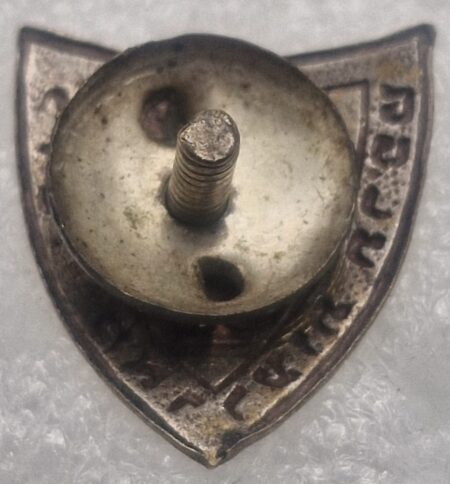
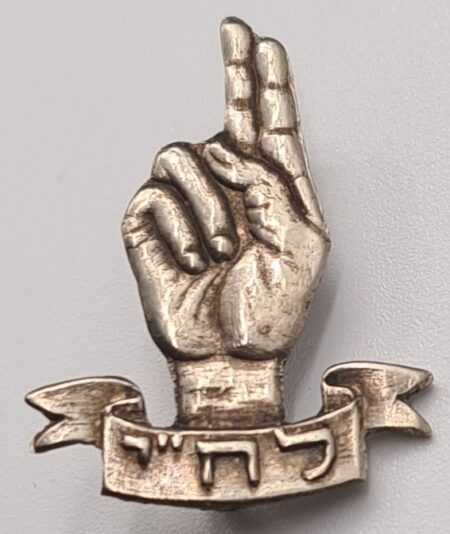
Length: 26 mm | Width: 17 mm
Weight: 1 g
Out of stock